Claude’s Price Didn’t Change. But Your API Bill Might.
The price per million tokens for several Claude models has stayed exactly the same. But the same amount of text can now use roughly 30% more tokens.
If your company uses Claude through the API, there is a pricing change worth paying attention to.
And strangely, it is not really a pricing change.
The price per million tokens for several Claude models has stayed exactly the same. But the same amount of text can now use roughly 30% more tokens.
Since API customers pay by the token, that matters.
The reason is a new tokenizer.
Anthropic says Claude 4.7 and later models use a newer tokenizer that produces approximately 30% more tokens for the same text, although the exact increase varies by workload. Claude Sonnet 4.6 and earlier use the previous tokenizer.
So if you manage AI costs inside an enterprise, looking only at the advertised price per million tokens can now be misleading.
First, What Is a Tokenizer?
Before an AI model reads your prompt, the text has to be broken into smaller units called tokens.
The tokenizer decides how that text gets divided.
Imagine that 1,000 words previously became 1,300 tokens.
With a different tokenizer, exactly the same 1,000 words might become around 1,690 tokens.
You have not sent Claude more information.
But Claude may now count more tokens.
And because API pricing is based on token usage, your cost can increase even when the headline price stays unchanged.
That is the important part.
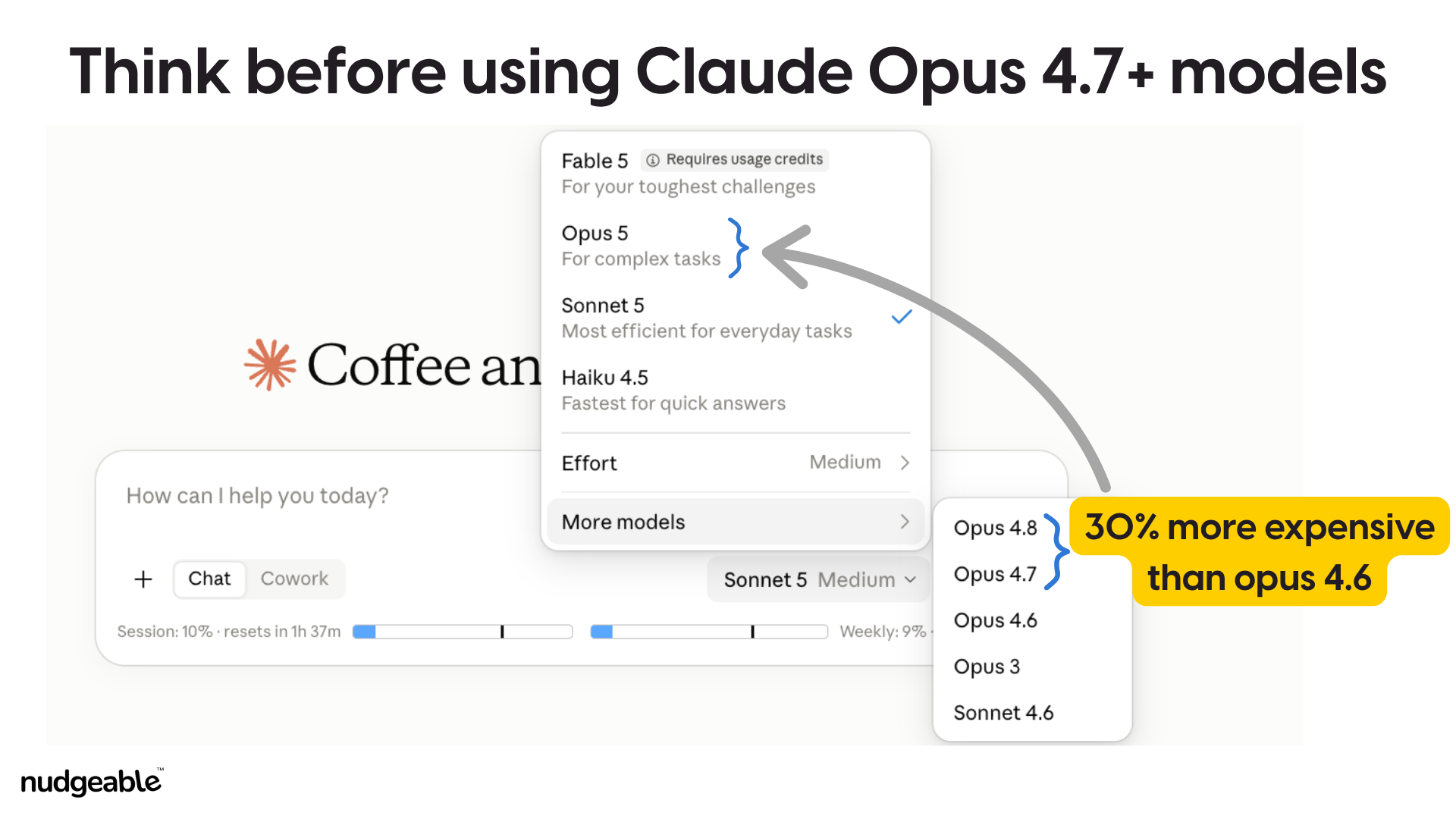
Look at Opus 4.6 vs Opus 4.7
This is where the impact is easiest to see.
Anthropic currently charges the same API price for:
- Opus 4.6: $5 per million input tokens / $25 output
- Opus 4.7: $5 / $25
- Opus 4.8: $5 / $25
- Opus 5: $5 / $25
On a pricing table, they look identical.
But Opus 4.6 uses the older tokenizer, while Opus 4.7 and later models use the newer one. Anthropic says Opus 4.7 can map the same input to roughly 1.0 to 1.35 times as many tokens, depending on the content.
So take a workload that costs $100 in input tokens on Opus 4.6.
If the exact same text produces 30% more tokens on Opus 4.7, the equivalent input cost could become roughly:
$100 → $130
The model price did not increase.
The amount of billable units did.
That distinction becomes extremely important when an enterprise is processing millions or billions of tokens.
Sonnet 5 Is the Interesting Exception
Sonnet 5 also uses the new tokenizer.
But Anthropic reduced its per-token price substantially.
Current pricing is:
Sonnet 4.6: $3 input / $15 output per million tokens
Sonnet 5: $2 input / $10 output per million tokens
At first glance, Sonnet 5 looks 33% cheaper.
Now adjust for roughly 30% more tokens.
If a piece of text used 1 million input tokens on Sonnet 4.6:
Sonnet 4.6:
1M × $3 = $3.00
If approximately the same text becomes 1.3 million tokens on Sonnet 5:
Sonnet 5:
1.3M × $2 = $2.60
So for an equivalent amount of text, Sonnet 5 is closer to 13% cheaper, rather than 33% cheaper.
The exact number will vary because the tokenizer difference depends on the content, but this is a much more useful way to compare the models.
Anthropic itself makes this point in its Sonnet 5 documentation: the lower per-token pricing does not translate directly into the same percentage reduction in cost because the new tokenizer generates more tokens.
And Then There Is Haiku 4.5
Haiku 4.5 remains the cheapest of these commonly used Claude models:
$1 per million input tokens and $5 per million output tokens.
For straightforward classification, extraction, summarization, routing, or high-volume workflows where you do not need frontier-level reasoning, that price difference can become significant at enterprise scale.
Which leads to the bigger point.
Enterprises Need to Stop Choosing Models Only on CapabilityMost employees naturally want to use the smartest model available.
If the menu says:
Haiku → Sonnet → Opus
people assume:
Good → Better → Best
So they select Opus.
That may be perfectly reasonable when someone is solving a complex problem once.
It becomes expensive when thousands of employees, applications, agents, and automated workflows start doing the same thing every day.
The cost of enterprise AI will increasingly depend on something companies have historically never needed to teach employees:
model selection.
You do not need Opus 5 to summarize every document.
You do not need maximum reasoning for every email.
And an agent processing thousands of repetitive requests should not automatically reach for the most expensive model available.
The quality difference may be small for the task.
The cost difference at scale may not be.
The Bigger Insight: Stop Comparing AI Models Using Sticker Prices
The pricing page tells you:
$5 per million tokens.
But that number alone no longer tells you what the workload will actually cost.
A better comparison is:
Cost per completed task.
If Model A charges less per token but uses more tokens, the apparent saving shrinks.
If Model B costs more but completes the task correctly in one attempt instead of three, it may actually be cheaper.
If an Opus model reasons for much longer at higher effort settings, output-token costs can rise further. Anthropic specifically notes that Opus 4.7 can think more at higher effort levels, which can increase output usage.
So enterprise AI teams need to measure models against real workloads rather than simply reading the pricing table.
Take 100 representative tasks.
Run them through Haiku, Sonnet, and Opus.
Measure quality.
Measure total token consumption.
Measure retries.
Then calculate:
How much did it actually cost us to complete the task successfully?
That number is far more useful than price per million tokens.
What Enterprises Should Do NowIf your organization uses Claude extensively, I would send a simple advisory to employees and AI teams:
Use Opus 4.7 and later when the additional capability is genuinely needed. Default routine work to Sonnet or Haiku where they perform well enough.
For API and agentic workloads, go one step further.
Track actual token consumption before and after upgrading models.
Anthropic itself recommends measuring Opus 4.7 against real traffic because tokenizer usage varies by workload.
And avoid automatically upgrading every workflow simply because a newer model has launched.
A newer model may be more capable.
But at enterprise scale, there is another question that matters just as much:
How much does it cost to get the job done?
That is going to become one of the most important questions in enterprise AI.