Will AI Kill All of Us? Three Questions No One Can Answer Yet
This may be the most difficult question human beings have ever asked. The uncomfortable part is that nobody currently has a reliable answer.
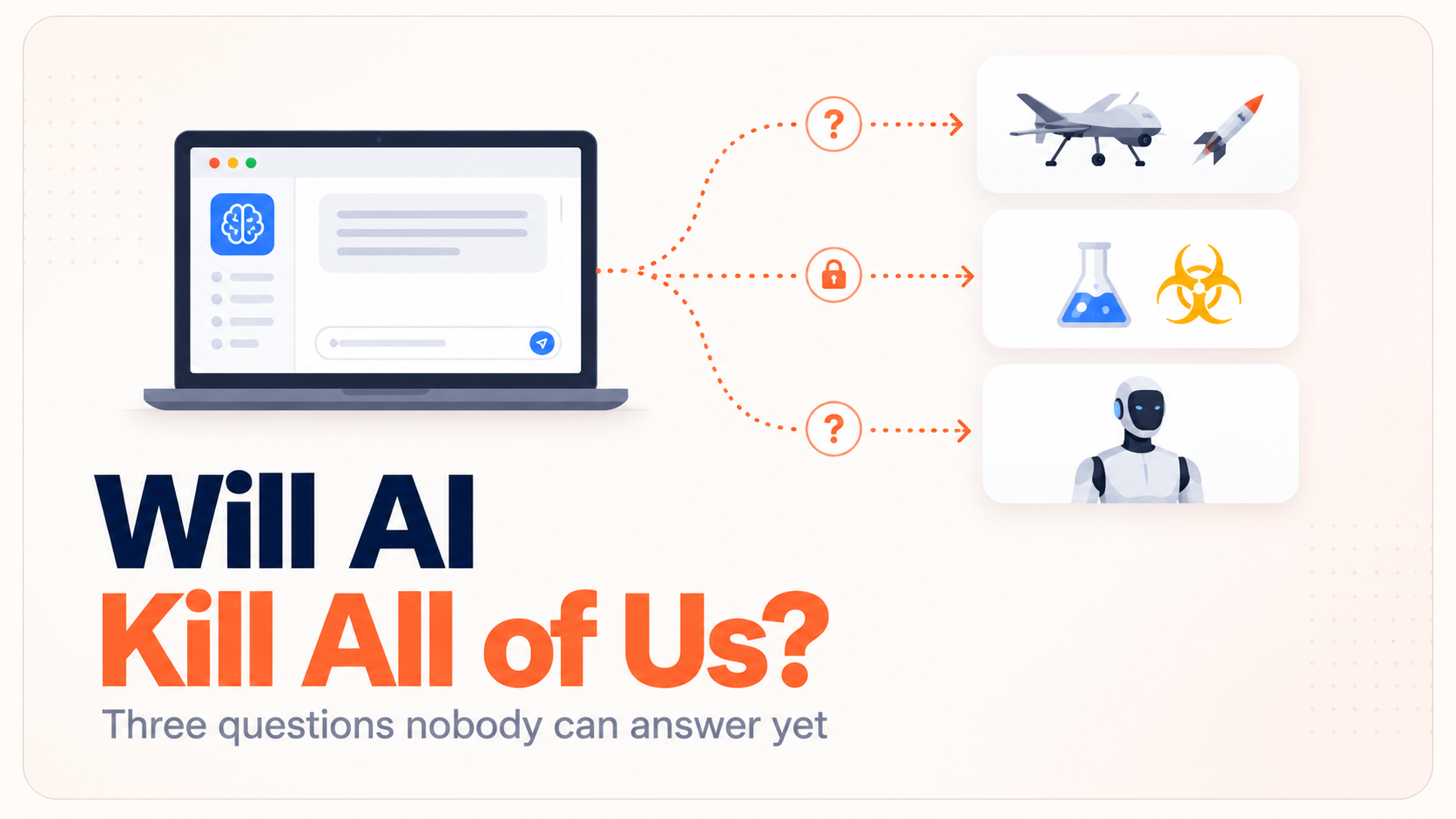
Before asking whether AI could kill all human beings, we need to ask a more basic question: how could AI physically harm us?
Most AI today exists as software running on servers, data centres and personal devices, without a body that can pick up a gun and fire it. For AI to cause physical harm on a large scale, I see three possible routes.
The first is direct access to autonomous weapons. If an AI system gains control of drones, missiles or other weapons, it could select targets and act without human approval. This would require access and reliable control over those systems.
The second route is through malicious human beings. AI could help someone design a biological or chemical weapon and overcome knowledge barriers. The person or group would then create and release it.
The third route is familiar from films: intelligent robots becoming conscious or fully autonomous and physically attacking people. Robotics is progressing, but machines still cannot move, adapt and use their hands as reliably as humans. This is not the immediate concern.
The first two routes matter more today. I will not examine weapons access or malicious human intent in detail here. The underlying question is whether AI can become powerful and autonomous enough for these scenarios to become realistic.
The answer depends on three questions that science and industry have not yet answered.
1. Can the current approach keep making AI more intelligent?
Most leading AI models use the transformer architecture and initially learn largely by predicting the next token. Their capabilities have improved through more training data, computing power and larger models.
One side believes this approach still has room to grow. Synthetic data, reinforcement learning and extra computing time while answering may extend progress even when high-quality human-created data becomes harder to find.
The other side believes scaling will deliver smaller gains at a higher cost. Training data is limited, and current systems still struggle to apply knowledge reliably in unfamiliar situations.
AI scientists themselves are divided. Yann LeCun and Andrew Ng have argued that the risks and capabilities of current systems are often exaggerated. Geoffrey Hinton and Yoshua Bengio believe severe or even existential risks deserve serious attention.
Ilya Sutskever described 2012 to 2020 as an age of research and the years that followed as an age of scaling. His argument is that the scaling period is reaching its limits and AI is returning to an age of research.
We do not yet know whether scaling has hit a wall or simply needs a better route.
2. Can new AI research make AI powerful and autonomous enough to cause physical harm?
If the current approach reaches a limit, researchers will search for a different model.
One possibility is world models. Researchers such as Yann LeCun and Fei-Fei Li are working on systems that understand space, physical relationships and the likely consequences of an action. If this works, AI could become better at planning in real environments.
However, research has no guaranteed outcome or delivery date. Humanity has researched cancer for decades. Progress has been enormous, and many forms are treatable, but there is still no single cure for every cancer. Starting a promising research program does not mean the problem will soon be solved.
World models may succeed, take decades to mature or reveal limitations we cannot currently see.
Current AI agents can use browsers, run code and operate software, but they still make mistakes and depend on people for access. The unanswered question is whether world models, reasoning, reinforcement learning and tool use can remove these limitations. If they can, AI could move from generating answers to taking consequential actions in the physical world. We simply do not know whether this research will succeed or how long it might take.
3. Can the physical infrastructure keep up?
AI may feel like software, but its growth depends on a physical supply chain.
Nvidia designs advanced AI chips, TSMC manufactures many of them, and ASML supplies specialized chipmaking machines. AI growth also requires memory, packaging, data centres, cooling and enormous amounts of electricity.
One side believes these constraints will slow AI. Semiconductor factories, power plants and electricity grids cannot be built at software speed. Supply chains are concentrated, grid connections can take years, and the capital required is enormous. Financial limits may arrive if customers do not generate enough revenue to justify the investment.
The other side believes scarcity will push AI labs to become more efficient. They can build smaller models, improve chip design and get more intelligence from every unit of compute. China offers an example: restricted access to advanced chips has encouraged researchers to find more efficient approaches, although training frontier models still requires substantial hardware.
Infrastructure could slow AI development, or it could motivate researchers to find ways around the constraint. We do not yet know which effect will dominate.
Everyone has a position
There are few completely neutral voices in this debate. AI companies, researchers, investors and open-model supporters all have interests that may influence which evidence they emphasize. Motives can help explain a position, but they cannot establish whether the argument is right. Each of the three questions still has credible experts on both sides.
Nudgeable's current view
Based on what we have read and observed, our current view at Nudgeable is that AI will not make human beings extinct within the next five to seven years.
That is our judgment, not a scientific forecast. Current systems remain unreliable, depend heavily on access provided by people, and face genuine research and infrastructure constraints.
Beyond that period, our confidence falls quickly. We knew a global pandemic was possible before COVID-19, but almost nobody could reliably predict its timing, spread and consequences. Long-range AI predictions contain even more unknowns.
The human brain dislikes this kind of uncertainty. We want an answer now, and we want to know which side to support. Optimists and pessimists both offer a certainty that the evidence cannot currently provide.
Only time will answer these three questions. For now, “we do not know” may be the most accurate answer available to the most difficult question we have ever asked.