Did Your Company Really Build Its Own AI Chatbot? Usually, One of Four Things Happened
An AI chatbot has several layers. The AI model produces the answer. The product layer adds company knowledge, tools, memory, permissions and workflows. The interface is where the employee types a question.
Sometimes that is accurate. More often, the company has built the screen employees use, while the intelligence behind it still comes from OpenAI, Anthropic, Google, Microsoft, Meta or another AI provider.
An AI chatbot has several layers. The AI model produces the answer. The product layer adds company knowledge, tools, memory, permissions and workflows. The interface is where the employee types a question.
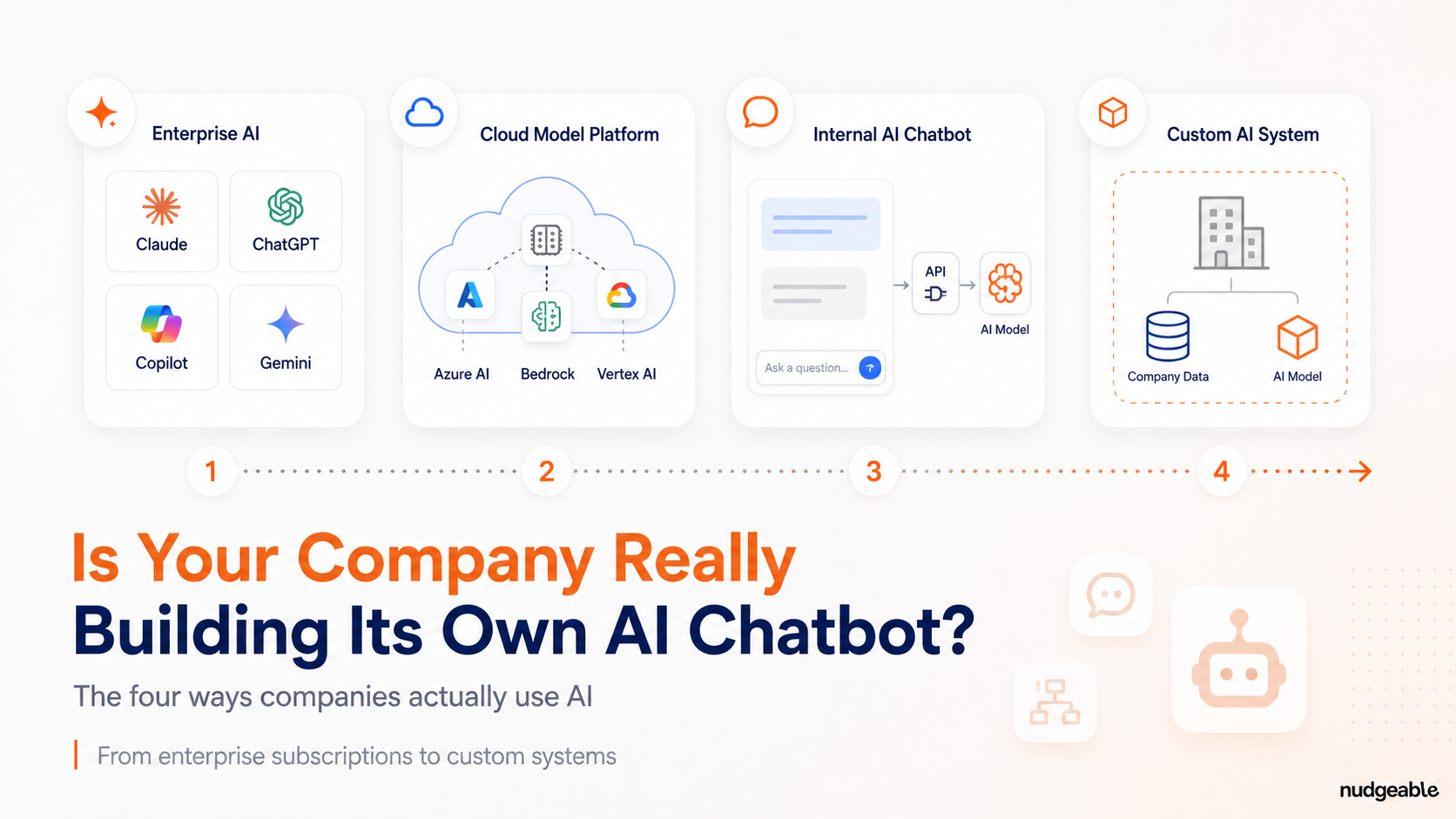
Employees usually see only the interface. If it carries the company logo, it can feel as though the company created the entire system. In reality, most large organizations provide AI to employees through one or more of four routes.
1. Buy a finished enterprise AI product
This is the simplest and usually the fastest route.
The company buys enterprise access to a finished product such as ChatGPT Enterprise, Claude Enterprise, Microsoft 365 Copilot or Google’s enterprise Gemini offering. Employees use the provider’s interface, while the company receives administrative and security controls.
The company gets much more than a model. Depending on the platform and plan, the surrounding product can include projects, skills, connected apps, scheduled work, shared agents and advanced work modes. OpenAI, for example, bundles ChatGPT, ChatGPT Work and Codex features into its business offering, while Anthropic’s enterprise suite includes Claude Chat, Claude Cowork and Claude Code. (OpenAI, Anthropic)
These features are sometimes called a harness. A harness helps the model use files, tools and instructions in a more useful way. The underlying model may be powerful, but the harness determines what employees can actually get done with it.
The trade-off is cost and dependence on one ecosystem. Per-user licenses can become expensive across thousands of employees. Even so, this route often gives employees the most complete experience with the least internal development.
2. Build through a cloud AI platform
Some companies prefer to work through the cloud provider they already use. They may build on Microsoft Foundry, Amazon Bedrock or Google’s Vertex AI environment, now part of the Gemini Enterprise Agent Platform.
Think of these platforms as managed model marketplaces. Instead of committing to one model company, an organization can access models from several providers inside one cloud environment. Microsoft Foundry lists models from OpenAI, Anthropic, Meta, Mistral and others. Amazon Bedrock also provides access to a large catalogue through unified APIs, while Google offers Google, partner and open models through its Model Garden. (Microsoft, AWS, Google Cloud)
This gives the company more choice and may fit more easily with its existing cloud security, billing and data controls.
Employees do not automatically receive the complete ChatGPT or Claude experience. These platforms provide building blocks such as model access, agents, knowledge bases and guardrails, but the company still has to configure or build the employee interface.
This route can reduce dependence on one model provider, but it is not automatically cheaper. The final cost includes model usage, cloud services, development, testing and ongoing support.
3. Buy model APIs and build the chatbot internally
The third route is to buy access directly from a model provider through an API.
An API is a controlled way for one software application to communicate with another. The company’s internal chatbot sends a request to an OpenAI, Anthropic or Gemini model through the API, then displays the response inside its own interface. OpenAI, Anthropic and Google all provide direct APIs for this purpose. (OpenAI, Anthropic, Google)
This can make sense for a highly customized experience or a narrow use case. It may also allow the company to route different requests to different models.
There is one important qualification: buying one provider’s API does not remove dependence on that provider. The company reduces that risk only if it connects to multiple providers or designs the system so models can be changed without rebuilding everything.
The company must build much of the product layer itself, including the interface, login, permissions, company knowledge search, integrations, monitoring and support. Direct API access does not recreate every feature inside ChatGPT or Claude. Anthropic’s documentation makes the distinction clear: with direct model access, the developer constructs each turn, manages conversation state and writes the tool loop.
For a focused workflow, this can be sensible. For a general chatbot used by thousands of employees, the internal engineering effort can be substantial.
4. Run an open-weight model on company-controlled infrastructure
The fourth route offers the greatest infrastructure control. The organization downloads an open-weight model, such as a model from the Llama family or another openly available model, and runs it on its own servers, private cloud or on-premises infrastructure.
People often call all such models “open source,” although the licenses and permitted uses vary. Open-weight is usually the more accurate term because the trained model weights are available, but the complete training data and development process may not be.
This route can appeal to organizations with strict data-residency requirements or specialized technical needs. It also brings serious operational responsibility. The company needs suitable hardware, model-serving software, security, monitoring and people who can keep the system current. Serving frameworks support deployments across multiple GPUs, which shows the infrastructure involved before an employee sees a simple chat box. (vLLM, Hugging Face)
For most companies outside technology, operating foundation models is far from the core business. That is why fully self-hosted employee chatbots remain the least common route in my experience. Even here, the company has usually deployed somebody else’s model rather than trained a new foundation model.
How can an employee find out which route the company uses?
If employees sign in directly to ChatGPT, Claude, Copilot or Gemini, the first route is usually obvious. A company-branded chatbot could use any of the other three routes, so its appearance tells you very little about what sits behind it.
Ask the IT or AI program team four questions:
Which model or models generate the answers?
Who hosts and operates those models?
Do we access them through an enterprise product, a cloud AI platform, direct APIs or self-hosted infrastructure?
Which features come from the provider, and which ones did our company build?
A company can use more than one route. It might provide Microsoft 365 Copilot to all employees and build a separate HR assistant on Amazon Bedrock.
So when someone says, “Our company built its own AI chatbot,” the right response is not to challenge the claim immediately. Ask what the company actually built. It may have created the interface, connected internal knowledge and added security controls, all of which can be valuable work. The AI brain underneath, however, was almost certainly built somewhere else.