Prompt, Context, Loop and Harness Engineering Explained
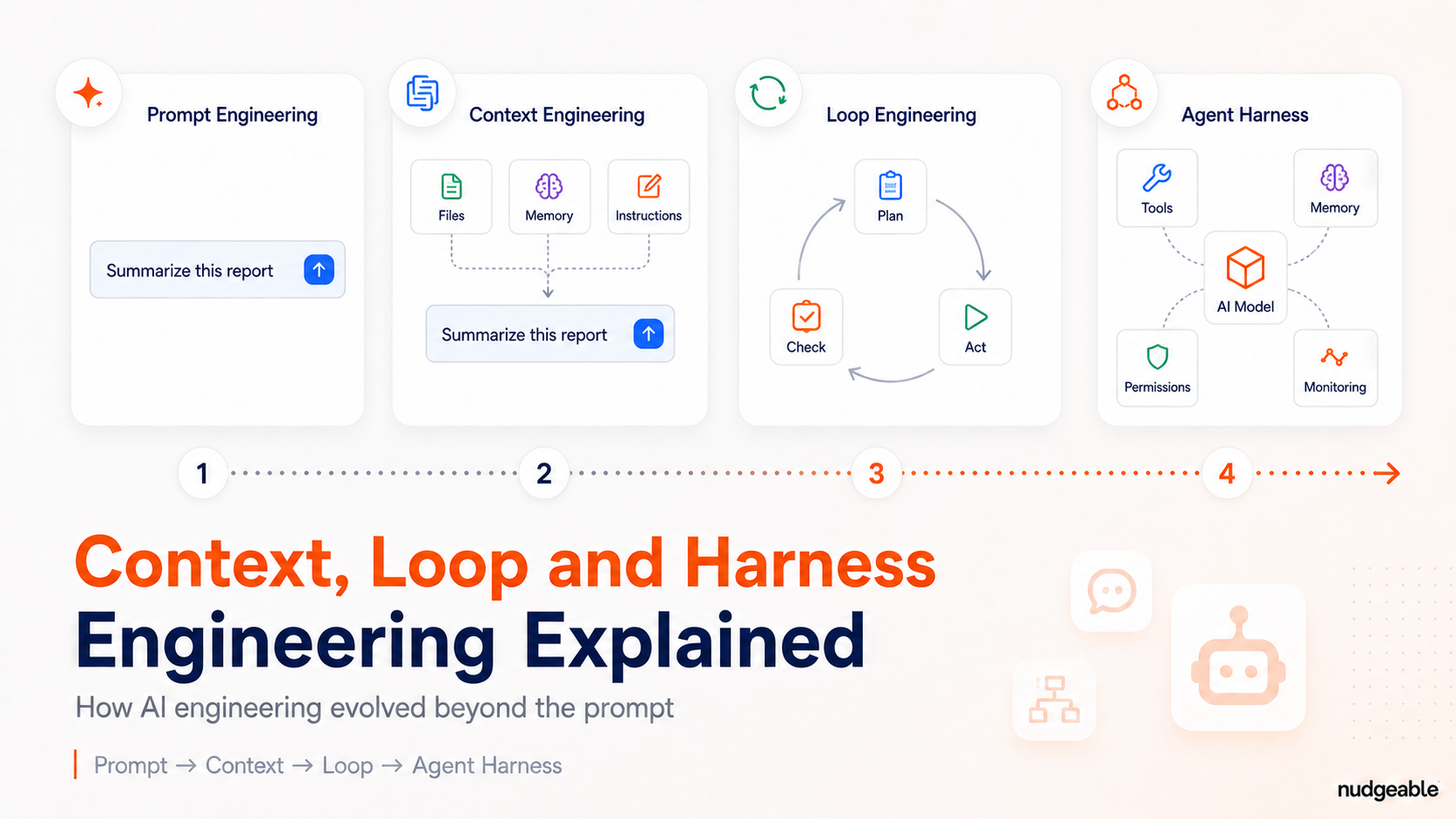
Prompt, context, loop and harness engineering describe four connected parts of working with AI. A prompt gives the instruction, context supplies the information, a loop helps AI continue and adjust, and the harness controls the environment in which an agent works.
Prompt engineering was the first major buzzword for generative AI.
Then came context engineering. In 2026, attention moved to loop engineering and agent harnesses.
The terminology makes AI sound more complicated than it needs to be. It also suggests that each new discipline replaced the previous one.
These terms describe connected parts of the same system. Prompt engineering asks how you should instruct AI. Context engineering asks what information it needs. Loop engineering asks how it should keep working. Harness engineering covers the environment, tools and controls surrounding the agent.
You can apply several ideas directly in ChatGPT, Claude or Gemini. Building a complete automated loop or harness usually requires technical work.
What do these four terms mean?
1. Prompt engineering asks: How should I ask?
Prompt engineering focuses on the instruction, goal and expected output.
For example:
"Summarise this employee survey in five findings. Support each finding with a number and avoid recommendations."
You have told AI what to produce, how to support it and what to leave out. A better prompt improves the request, but it cannot provide information AI has never received.
2. Context engineering asks: What does AI know?
Context includes the files, examples, background, conversation history and constraints available to the model.
Suppose you want AI to compare leadership programmes across three offices. You provide the programme outlines, participant feedback and completion data. You also explain how your company measures programme success.
The prompt gives the instruction. The added information gives AI enough context to make a useful comparison. Adding 50 unrelated documents may bury the information that matters.
3. Loop engineering asks: How does it keep working?
Loop engineering designs a cycle in which AI acts, checks the result, adjusts and continues until it reaches a stopping condition.
Suppose AI builds a dashboard from an Excel workbook. You ask it to compare every dashboard total with the original workbook, fix any mismatch and stop only when all totals match.
In a normal chat, this may be a lightweight self-check. An engineered loop can make repeated model calls, carry progress forward and continue without waiting for another human prompt.
4. Harness engineering asks: What can it access and do?
The harness is the wider system around an agent. It manages tools, memory, permissions, approvals and other software controls.
Consider an HR assistant that answers policy questions. The harness may allow it to read the employee handbook but block salary files. It may let the agent draft an email while requiring human approval before sending it.
Writing an approval rule in the prompt guides the model. Building that approval into the software prevents the action from continuing without confirmation.
A prompt forms part of the context. The context changes as the loop generates new information. The harness manages the wider environment in which the loop operates.
Did each discipline replace the previous one?
No. Prompt engineering dominated the early chatbot period. Context engineering became prominent in 2025, followed by more discussion of harness and loop engineering in 2026 as agents began working across tools and multiple steps.
The newer layers address additional problems; they do not make prompting irrelevant. The correct term is context engineering, rather than content engineering.
How do the four layers work together?
Imagine an agent handling a customer refund request.
The prompt tells it to assess the request and explain the decision. The context contains the order, customer history and refund policy. The loop checks eligibility, prepares the response and verifies that the decision follows the policy.
The harness controls which customer records the agent can open. It may allow refunds under ₹5,000 while requiring manager approval above that amount. It also records the actions taken and handles a failed connection to the payment system.
This example shows why the terms overlap. The prompt sits inside the context, the context changes during the loop, and the harness controls the complete process.
Can non-technical people use these concepts?
Yes, but at different depths.
In ChatGPT, Claude or Gemini, you control the prompt and much of the context. You can provide files, constraints and a test for the answer.
You can create a lightweight loop by asking AI to draft, check and revise. In an agentic mode, you may choose which folders, tools and approvals it receives. You are configuring parts of an existing harness.
No-code agent builders may let you define a trigger, connect tools and add approval.
Developers building through an Application Programming Interface, or API, must handle authentication, failures, memory, security and recovery.
The practical boundary is enforcement. Natural-language instructions can guide an agent. Access controls and software rules are needed when mistakes could send, publish, pay or change business data.
The simplest way to remember the difference
Ask four questions:
Prompt: What have I asked AI to do?
Context: What can AI see while doing it?
Loop: How will it check, adjust and continue?
Harness: What gives it tools, permissions and limits?
For a summary or email, focus on the prompt and context. For work that needs checking and revision, add a loop. When AI can act in another system, examine the harness and its approval rules.
Start with the smallest setup that can complete the work reliably.