Why Company Values Rarely Change Workplace Culture
Company values can sound inspiring while leaving employees unsure about what to do differently. This blog explains how organizations can translate abstract values into visible behaviors, aligned systems and everyday leadership actions.
An organization decides to change its culture.
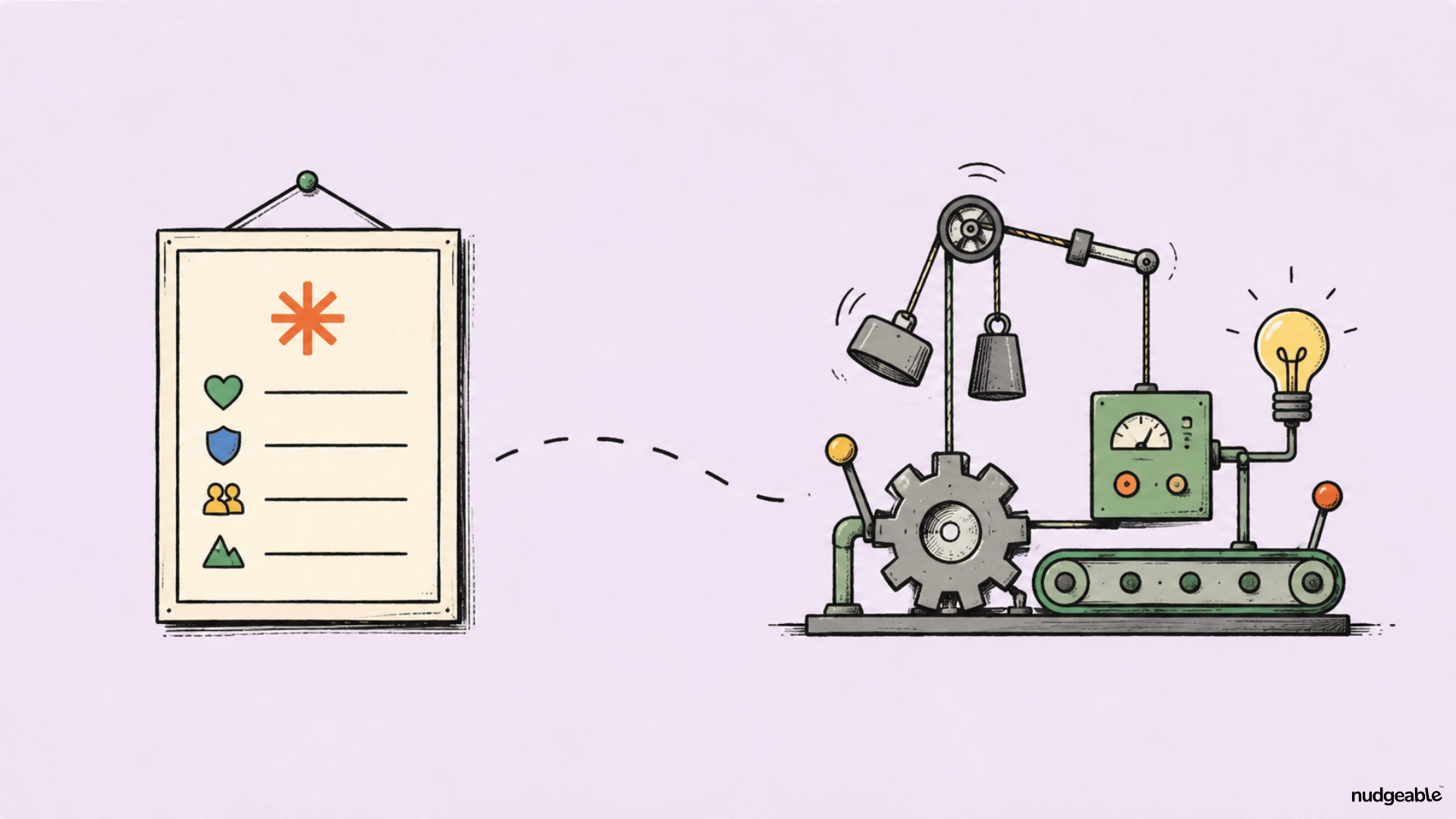
A new set of values is created after several leadership discussions. Words such as innovation, ownership, collaboration and customer obsession appear on posters, presentation templates and office walls.
Employees attend a launch event where senior leaders explain why the values matter. A few months later, most people are still working exactly as they did before.
The values may be perfectly sensible. The problem is that employees cannot see what they are expected to do differently on Monday morning.
Key insight: Culture changes when abstract values are translated into actions that people can observe, practise and experience repeatedly.
Abstract values invite different interpretations
Ask ten employees what “innovation” means and you may receive ten different answers.
One person may interpret it as proposing bold ideas. Another may think it means using new technology, while someone else may see innovation as improving an existing process.
The same problem appears with values such as:
- Ownership
- Agility
- Respect
- Excellence
- Collaboration
- Customer focus
These words describe a desirable direction, but they provide limited behavioral guidance.
Our brain finds concrete information easier to understand and remember. “Be collaborative” is open to interpretation. “Invite the affected team before finalizing a decision” gives employees something they can actually do.
Values influence behavior through beliefs
A value is something we consider important. A belief is something we think is true, even when it cannot be conclusively proven.
Imagine that a manager values collaboration but also believes that involving more people slows down decisions. When a deadline becomes tight, the belief may have a stronger influence than the published value.
Another leader may value innovation but believe that mistakes damage credibility. Their team will quickly learn to avoid uncertain ideas.
This is why agreement with a value does not guarantee aligned behavior. Organizations need to examine the beliefs and systems surrounding that value.
Key insight: Employees learn what the culture truly values by watching which behaviors are rewarded, ignored and punished.
Rewards can preserve the old culture
Imagine that a company announces collaboration as a new value but continues rewarding only individual results.
Employees receive the message that collaboration looks good on a poster, while individual achievement still determines recognition, ratings and promotion.
Culture change needs alignment across:
- Performance expectations
- Promotion decisions
- Recognition programs
- Leadership appointments
- Team goals
- Everyday feedback
If an organization wants leaders to develop their people, it should recognize managers who invest time in coaching. If customer focus matters, employees who solve difficult customer problems should receive visible appreciation.
The organization also needs to stop rewarding behaviors associated with the previous culture. A leader who consistently delivers results by exhausting the team should not continue receiving praise for performance without any discussion of the cost.
Leaders define culture during difficult moments
Employees watch what leaders do when following the stated value becomes inconvenient.
A leader may encourage people to challenge ideas. The real test comes when an employee challenges the leader’s own proposal.
A company may say that wellbeing matters. Employees will judge that claim when a client deadline requires weekend work.
Leaders model culture through decisions such as:
- Whose opinions they invite
- Which mistakes they forgive
- How they respond to disagreement
- What they prioritize under pressure
- Who receives recognition and promotion
McKinsey’s work on organizational culture transformation similarly emphasizes embedding new rituals and repeatedly revisiting roles, mindsets and behaviors.
Employees believe culture statements when leadership behavior provides supporting evidence.
Group identities can create silos
Culture is also influenced by the groups people belong to.
At work, employees are categorized as sales, marketing, finance, HR or technology. These functional groups become part of their professional identity.
Because we want to feel positive about our own group, blaming another function can become easier than examining our contribution to a problem.
This is how silos develop even when collaboration is a stated value.
One way to reduce this tendency is to organize work around a shared customer outcome. Instead of dividing people only by skill, bring different functions together around an end-to-end problem they jointly own.
The common goal gives the group a new identity.
Replace the culture launch with repeated action
Culture change rarely comes from one dramatic intervention. It is more likely to emerge through many small improvements repeated over time.
Organizations can use a simple process:
- Choose the priority behavior. Avoid trying to change everything at once.
- Define observable actions. Show what the behavior looks like in meetings, decisions and customer interactions.
- Remove conflicting signals. Review rewards, ratings and leadership practices.
- Ask leaders to model it. Employees need visible examples from people with authority.
- Recognize early examples. Make the new behavior easier for others to notice and copy.
- Measure application. Track whether people are using the behavior, rather than only asking whether they understand the value.
For example, “build an inclusive culture” might become:
- Invite opinions before the senior leader speaks.
- Rotate important meeting responsibilities.
- Ask who may be affected before making a decision.
- Credit the person who originally contributed an idea.
Turn cultural values into everyday actions
The Nudgeable Actions Engine can support culture and leadership programs by converting broad values into specific workplace actions. Employees choose relevant actions, practise them during work and receive timely nudges to keep the commitment active.
This gives HR visibility into whether the culture program moved beyond communication and entered everyday behavior.
Culture is the pattern employees experience repeatedly. If organizations want that pattern to change, values need to become visible in meetings, decisions, rewards and leadership actions.
The poster can introduce the value. What people repeatedly do determines whether anyone believes it.