What Makes a Company AI-Native?
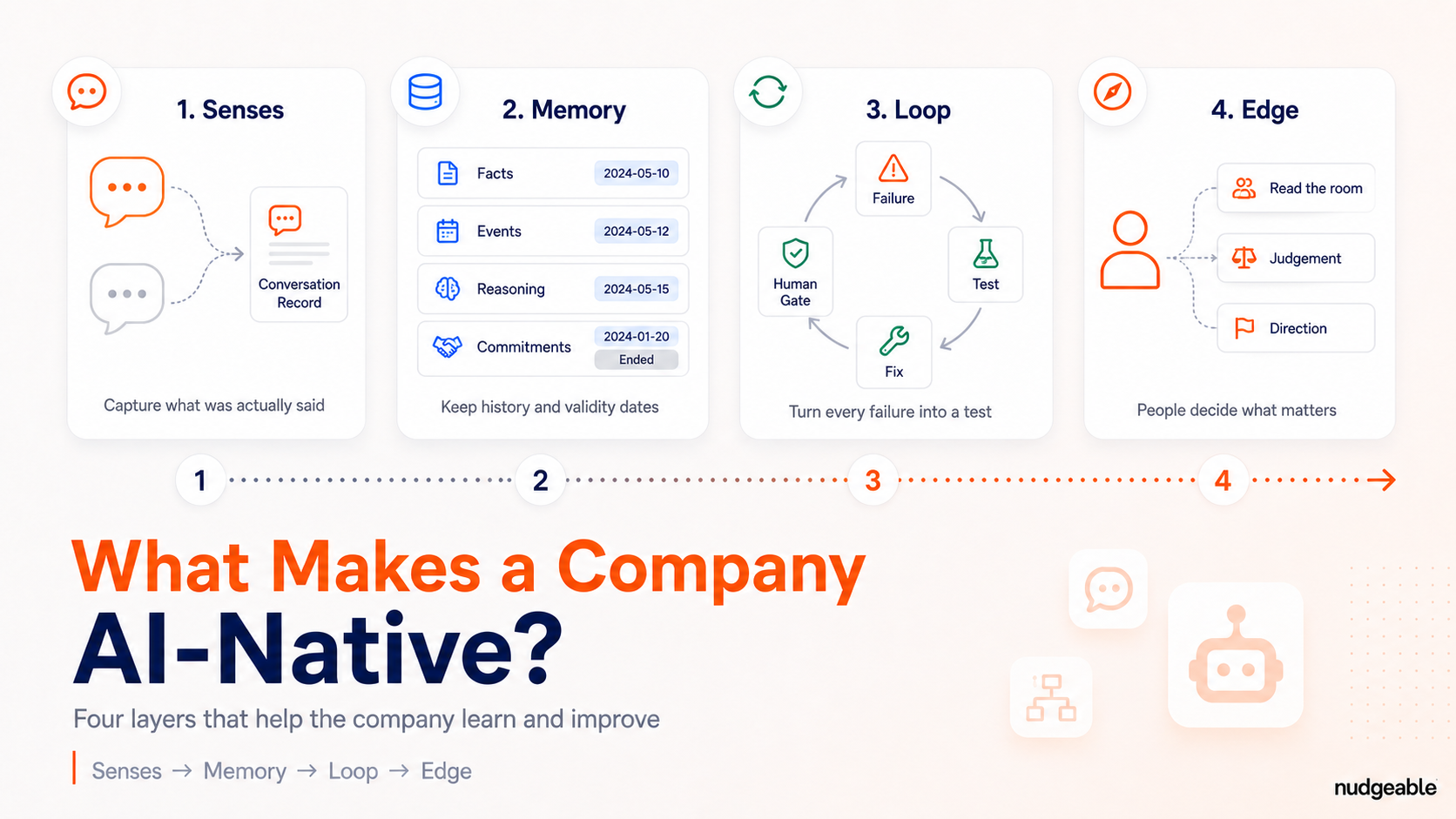
An AI-native company needs four layers: senses, memory, a learning loop and a clear human edge. It captures what happened, remembers why decisions were made, learns from mistakes and directs people towards the work that still requires human judgement.
Look at how AI is being used inside most companies and you will usually find three types of work.
- The first is questions and answers. Someone asks ChatGPT or Claude a question, reads the reply and moves on.
- The second is text work: rewriting an email, summarising a document or turning meeting notes into a cleaner format.
- A smaller group has built repeatable workflows. For example, an HR team may create an AI skill that turns interview notes into a standard evaluation report.
All three are useful, but most of the value stays with the individual.
The answer sits inside one person’s chat history. The rewritten email disappears into Outlook. The useful interview workflow works only because one recruiter knows where to find it.
The employee becomes faster, but the company learns very little.
An AI-native company captures what happened, remembers why decisions were made, learns from mistakes and directs people towards the work that still requires human judgement.
I think of this company brain as four layers: senses, memory, loop and edge.
Is your company actually AI-native?
Venture capital firm CRV uses a useful test for AI products: remove the AI and see whether the product stops working or merely loses a feature.
You can apply a similar test to your company.
If access to ChatGPT, Claude, Gemini and Copilot disappeared on Monday morning, would important work stop? Or would employees return to the way they worked in 2023?
Most companies would return to their earlier workflows. That is a reasonable starting point, provided leaders are honest about it.
The second test is what happens when AI models improve.
Suppose the next Claude or ChatGPT model becomes much better at analysing contracts. Will every relevant team benefit through an existing workflow, or will someone need to start another pilot?
An AI-native company can adopt a stronger model within its existing systems, permissions and test process. It still needs evaluation, because a new model can also change how a workflow behaves.
If every improvement requires a new project, the company has bought AI tools without building an AI operating system.
1. Senses: Capture the work as it happens
Most company systems contain what someone remembered to enter after the event.
Consider a sales call.
The salesperson enters this into Salesforce:
“Call went well. Client is interested. Follow up next week.”
The actual call contained far more useful information. The client mentioned a competitor, questioned the price, asked about data security and revealed that the Chief Financial Officer will approve the purchase.
That information may sit inside a recording, a salesperson’s notebook or nowhere at all.
An AI-native company captures the conversation itself, with the right consent and access controls. The transcript becomes the source material from which the summary, objections, commitments and follow-up actions are produced.
The same principle applies elsewhere.
A support conversation contains the customer’s exact problem and emotional reaction. An interview contains evidence about a candidate that never reaches the final scorecard. A project meeting contains assumptions that disappear from the weekly status report.
You do not need to record every interaction across the company immediately.
Start with one repeated interaction that already exists in a usable format. Customer support conversations are often the easiest because they are already stored as text.
The limitation is governance. Before capturing more information, you need clear rules for consent, access, retention and sensitive data.
2. Memory: Store more than documents
A folder full of transcripts is still a folder.
Useful company memory needs to separate four types of information.
Facts describe what is true now, such as prices, policies and product features.
Events record what happened, who was involved and when it occurred.
Reasoning explains why a decision was made.
Commitments record what was promised, who owns it and whether it was completed.
Most companies store facts and some events. Reasoning and commitments are far less reliable.
Imagine that a new HR director finds an old policy allowing employees to work remotely from any country. The document looks official, so she uses it to answer an employee query.
What she cannot see is that the policy was withdrawn after tax and compliance problems. The discussion happened in a meeting, while the final decision remained inside an email thread.
This is why putting every document into SharePoint, Google Drive or Confluence rarely creates dependable company memory.
The system also needs dates. It should know when a fact became valid and when it stopped being valid.
For example:
“The travel reimbursement limit increased from ₹2,000 to ₹3,000 on 1 April 2026.”
Without those dates, an AI system may find both policies and confidently return the older one.
When this layer works, an employee can ask why a pricing rule exists, what was tried previously and which customer commitments remain open. The answer can include the relevant evidence instead of relying on somebody’s memory.
3. Loop: Turn mistakes into permanent improvements
This layer determines whether the company becomes better at using AI over time.
Suppose an internal HR assistant tells an employee that unused leave will be paid out when they resign. The answer is wrong because the policy changed three months ago.
In most companies, the employee reports the mistake, someone corrects the answer and everyone moves on.
In a proper learning loop, the mistake becomes a permanent test case:
“An employee in India resigns with seven unused leave days. What happens to the balance?”
The team updates the source information or instructions. Before releasing that change, the assistant must answer this case and every important past case correctly.
A basic loop contains four steps:
- Capture the wrong answer or failed output.
- Turn it into a test case.
- update the information, instructions or workflow.
- Run the complete test set before publishing the new version.
A person should approve high-impact changes involving employees, money, customers or compliance.
This process can run weekly. Over time, the company builds a test library based on its actual mistakes, edge cases and operating decisions.
The fully autonomous version, where AI rewrites its own instructions overnight and releases them without review, remains risky for serious company work.
Without test gates and version history, a fix for one problem can create three new ones. The company may only discover the damage when a customer or employee complains.
4. Edge: Move people towards uncertain work
Once the first three layers work, people can spend less time collecting, moving and reformatting information.
A manager may no longer need to chase five project updates and turn them into a PowerPoint slide. The system can collect the updates, identify delays and prepare the first draft.
The manager still needs to judge whether a delay is acceptable, challenge an unrealistic explanation and negotiate additional support.
That is the human edge.
It includes reading tension in a client meeting, hearing the concern nobody has said directly, knowing which stakeholder holds real influence and deciding when a standard policy should make room for an unusual situation.
It also includes coaching someone through a difficult period and deciding what the company should prioritise in the first place.
Managers whose main work is moving information between teams may see a large part of their role change. Managers who spend their time making judgements, coaching people and handling difficult stakeholders remain central.
The practical challenge is identifying the boundary. Companies need clear escalation rules so the system knows when confidence is low, risk is high or a human relationship matters more than speed.
Why do AI-first efforts go wrong?
Companies get into trouble when they begin by removing people before building the earlier layers.
Klarna promoted its AI customer-service results and reduced headcount, partly through attrition. It later resumed hiring customer-service staff as its chief executive acknowledged that focusing heavily on cost had affected service quality. Reuters later reported that Klarna had shifted its AI focus from cost reduction towards better services and products.
Duolingo faced a similar communication problem. Its chief executive announced an “AI-first” approach and later clarified that the company still planned to hire people and did not see AI as replacing employees. The company also reversed its plan to assess employees based on AI usage.
Shopify took a different route. Its chief executive told teams to demonstrate why work could not be completed using AI before requesting more people or resources. That rule pushes teams to examine the work before deciding whether additional headcount is the answer. The memo also made regular AI use a general expectation.
The lesson is straightforward. Headcount reduction should not be the first sign that a company is becoming AI-native.
First capture the work. Build dependable memory. Create a learning loop. Then decide where human judgement adds the most value.
The practical rule I use
Choose one team with a repeated, text-heavy interaction. Customer support, inside sales and recruitment screening are practical starting points.
Capture that interaction properly for four weeks. Record the reasoning that normally disappears, including why a pricing exception exists or why an escalation threshold was chosen.
Give the team one approved AI entry point that can read the relevant information while respecting permissions.
Log every wrong answer. Turn each important failure into a permanent test case. Review the failures weekly, update the workflow and run the complete test set before releasing the next version.
Avoid measuring success through chatbot logins or the number of prompts written.
Measure whether a new support employee reaches full productivity faster. Check whether sales follow-ups capture more of the objections raised during calls. Track whether recruiters produce more consistent candidate assessments.
Those results show whether the company is learning.
At your next leadership meeting, ask three questions:
- If your most experienced person left tonight, how much knowledge would leave with them?
- Is your company better at its core work this week than it was last week?
- How much time goes into moving information rather than judging, deciding or persuading?
Pick the weakest answer and build your first company-memory workflow around it.