Training Doesn't Fail. Follow-Through Does
After a two-day workshop on psychological safety, Jon was energized and inspired. Three months later, his team's behavior hadn't changed at all. Sound familiar?

Organizations spend millions on leadership programs, culture change, capability building, and behavioral training.
Then, a few months later, someone asks:
“Why are people still not doing this?”
That question usually leads to another intervention.
Another workshop. Another communication campaign. Another manager toolkit.
But there is a more basic question we rarely ask:
How much of what people learn in training actually gets applied at work?
The answer is uncomfortable.
A large part of workplace learning never translates into consistent behavior. Some commonly cited estimates suggest that as much as 70–80% of learning is never meaningfully applied on the job.
Even if the exact number varies by study, the underlying problem is hard to argue with.
Organizations are very good at measuring whether people attended training.
They are reasonably good at measuring whether people liked it.
They are sometimes good at measuring whether people learned something.
But they are much less disciplined about measuring what happened after people went back to work.
And that is where the real value of training is created.
We Measure Satisfaction Because It Is Easy
Most training programs still end with some version of a feedback form.
Was the facilitator engaging?
Was the content relevant?
Would you recommend this program?
These questions are useful, but they answer a very limited question:
Did people like the training?
They tell us almost nothing about whether behavior changed.
A participant can give a workshop 5/5, recommend the facilitator to everyone, and never use a single thing they learned.
That is the fundamental measurement problem.
We often measure the experience of training rather than the application of training.
Kirkpatrick Actually Gave Us the Answer Decades Ago
The Kirkpatrick Model has been around since the 1950s.
It describes four levels of training evaluation:
- Reaction: How did participants respond to the training?
- Learning: What did they actually learn?
- Behavior: Are they applying that learning at work?
- Results: Did the behavior contribute to meaningful business outcomes?
The model itself is not the problem.
The problem is where organizations stop.
Most measurement sits heavily at Level 1.
Some organizations move into Level 2 through assessments or knowledge checks.
Far fewer systematically measure Level 3.
And Level 4 becomes even harder because business outcomes are influenced by dozens of variables beyond the training itself.
But here is the part I think organizations underestimate:
Level 3 is much more measurable than we make it sound.
The challenge is that we often define behavior too vaguely.
The Real Journey Is Knowledge → Intention → Action → Repetition
Training often assumes a very simple model:
Teach someone something → they understand it → behavior changes.
Human behavior does not work that way.
A more useful sequence is:
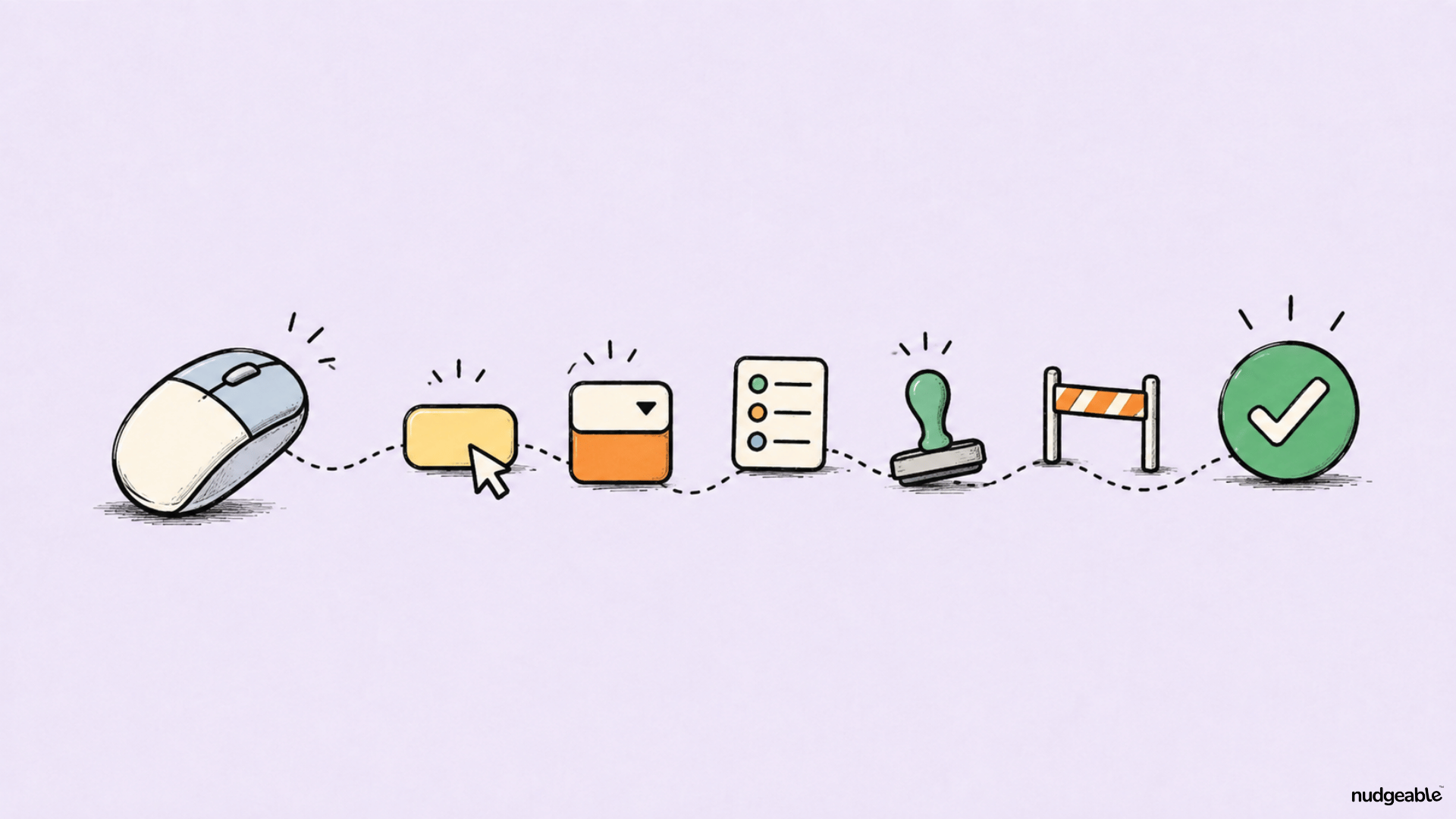
Knowledge → Intention → Action → Repetition
This is the journey we see in almost every kind of behavior change.
Take exercise.
Most people already know exercise is good for them.
Knowledge is not the bottleneck.
The real challenge is deciding to exercise, actually doing it when work gets busy, and then repeating the behavior often enough that it becomes part of normal life.
Workplace behavior is no different.
The problem is that most organizations invest heavily in the first stage and hope the other three happen automatically.
They rarely do.
Stage 1: Knowledge
This is where almost every training program performs reasonably well.
People learn about psychological safety, inclusive leadership, coaching, collaboration, feedback, or decision-making.
They understand the models.
They understand the research.
They understand why the behavior matters.
Then the training ends.
And we quietly assume that understanding will translate into action.
But knowing what to do and actually doing it are very different things.
Stage 2: Intention
This is an important stage that often gets ignored.
After a good workshop, people usually leave motivated.
They say things like:
“I need to give feedback more quickly.”
“I should involve quieter people in meetings.”
“I need to listen more before jumping to solutions.”
That is useful.
But intention is still not behavior.
I can genuinely intend to go to the gym tomorrow morning and still hit snooze at 6:30.
At work, the same thing happens.
People leave training with genuine intent, then return to emails, deadlines, client calls, meetings and old habits.
That is why intention itself is worth capturing.
Ask people:
What specifically are you going to do differently?
If they cannot answer that clearly, the chances of application are already low.
Stage 3: Action
This is where the knowing-doing gap becomes visible.
The employee understood the concept.
They intended to use it.
Then real work happened.
The meeting ran over.
The conversation felt uncomfortable.
The manager did not model the behavior.
There was no reminder at the moment it mattered.
The employee worried about getting it wrong.
So nothing happened.
This is why behavior change needs more than motivation.
It needs support at the moment of action.
A manager who learned psychological safety might need to actually say:
“What am I missing?”
at the end of the next team discussion.
Someone who learned inclusive leadership might need to deliberately invite one person who has not spoken yet.
A manager learning better feedback might need to schedule the conversation within 24 hours rather than wait for the next performance review.
These are observable actions.
Now we have something we can actually measure.
Stage 4: Repetition
Taking an action once is progress.
It is not behavior change.
Real change starts when the behavior becomes repeated enough that the person no longer needs to think hard about doing it.
A manager stops consciously reminding themselves to invite quieter voices because that is simply how they now run meetings.
A leader starts addressing feedback quickly because waiting three months feels unnatural.
The behavior becomes part of how they work.
This is the stage most training programs claim they want.
And ironically, it is the stage they track least.
The Biggest Problem Is Often Specificity
One of the biggest barriers to measuring behavior is that organizations define behavior at too high a level.
Take psychological safety.
What exactly are we measuring?
Whether someone “creates psychological safety”?
That is almost impossible to observe consistently.
Now convert it into actions:
- Ask “What am I missing?” before closing an important discussion.
- Respond to a mistake by asking “What can we learn from this?”
- Share one example of something you personally got wrong.
- Invite someone who has not spoken yet before moving to a decision.
Now psychological safety becomes visible.
The same applies to something like Radical Candor.
Instead of measuring whether a manager “demonstrates candid feedback,” define what good application looks like:
- Give feedback close to the moment rather than waiting for appraisal season.
- Describe the specific behavior rather than judging the person.
- Explain the impact.
- Agree on one change for next time.
Once behavior becomes specific, measurement becomes much easier.
Vague behaviors create vague measurement. Specific actions create observable evidence.
How Training Measurement Should Actually Work
If organizations genuinely want to know whether a training program worked, they need to measure more than attendance and satisfaction.
Start with the behavior you are trying to change.
Then track the journey.
1. Knowledge
Did the participant understand the idea?
Use an assessment, scenario, exercise or knowledge check.
2. Intention
What are they planning to do differently?
Ask them to commit to specific actions before leaving the program.
3. Action
Did they actually do it?
Use self-reporting, manager observations, peer feedback, action tracking or structured check-ins.
4. Repetition
Is the behavior continuing?
Look again after 30, 60 or 90 days.
The measurement does not need to be academically perfect.
This is an important point.
Organizations sometimes avoid Level 3 measurement because they cannot prove causality with scientific precision.
But the choice is not between perfect measurement and no measurement.
A combination of action tracking, self-reporting, manager observation and peer feedback can tell you far more than a smile sheet ever will.
We Need to Shift Investment Beyond the Classroom
Companies spend enormous effort making training engaging.
Better facilitators.
Better content.
Better slides.
Better simulations.
All of that matters.
But if the intervention stops when the session ends, we are putting almost all the investment into the easiest part of the behavior-change journey.
The harder part begins the next morning.
That is when someone has to remember the idea, identify the right moment, overcome old habits and actually try the new behavior.
This is where manager reinforcement, peer accountability, reminders, micro-actions and environmental cues become important.
The goal should not simply be:
“Did they learn it?”
A much more useful question is:
“Did they use it?”
This Is Why We Built the Nudgeable Action Management Platform
This knowing-doing gap is one of the reasons we built the Nudgeable Action Management Platform.
After a training program, participants can turn their learning or application goals into specific actions they can take at work.
Those actions are then brought back into the flow of work through nudges and reminders.
Instead of only knowing that 200 employees attended a program, organizations can start seeing something much more useful:
What did people commit to doing?
What actions did they actually take?
Are they continuing to practise those behaviors over time?
That does not solve every part of behavior change.
Leadership, systems, incentives and manager reinforcement still matter.
But it gives organizations visibility into an area that training measurement has ignored for too long:
application.
A Simple Test for Your Next Training Program
Take one behavior from your next leadership or culture program.
Not ten.
Just one.
Define three specific actions that would demonstrate that behavior at work.
Then track them.
Did people intend to do them?
Did they actually do them?
Did they repeat them?
Are they still doing them three months later?
If you can answer those questions, you know far more about the effectiveness of your training than any post-session satisfaction score can tell you.
Because the value of training is not created when someone understands an idea.
It is created when that idea changes what they actually do at work.